

Johannesburg Residents Clash with Police Amid Water Crisis: Rubber Bullets and Tear Gas Deployed
Johannesburg Residents Clash with Police Amid Water Crisis: Rubber Bullets and Tear Gas Deployed
Natalie Nyathi
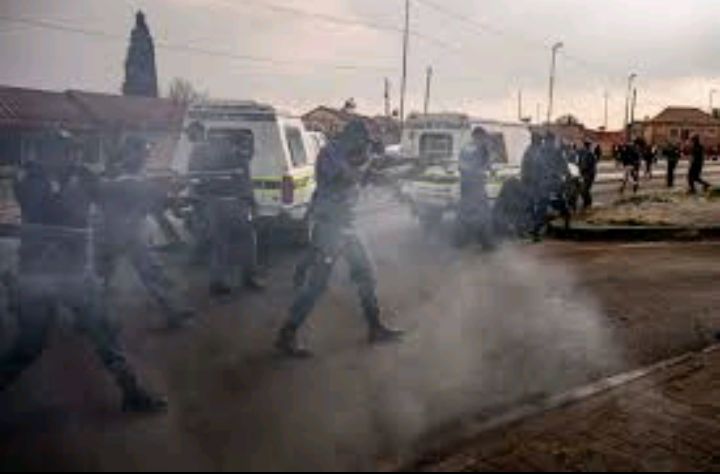
Tensions have reached a boiling point in several Johannesburg communities as residents, deprived of consistent water supply, took to the streets in protest. The demonstrations in Westbury and Coronationville turned violent, with police resorting to tear gas and rubber bullets to disperse the crowds.
For nearly a week, residents of Westbury and Coronationville have been without water, exacerbating a crisis that many claim has persisted for years. Protesters blocked key roads, burning tires and throwing rocks, demanding immediate intervention from city officials. They voiced their anger and a sense of neglect, directing their frustration towards Mayor Dada Morero and calling for the premier to address their concerns. One elderly resident stated they wanted the premier to visit instead of the mayor because the mayor had failed.
“We don’t want the mayor of Johannesburg, Dada Morero, he has failed, we want his boss, the premier [to visit us],” the elderly resident said.
The police responded to the protests with force, deploying stun grenades, tear gas, and rubber bullets. This response led to injuries among residents and journalists covering the events. A journalist from the Daily Maverick, Julia Evans, was shot in the leg with a rubber bullet while reporting on the protest. A 15-year-old boy was hospitalized after being shot in the head.
Gauteng police spokesperson Lieutenant Colonel Mavela Masondo stated that police used “minimum force” to disperse crowds who were blockading roads and throwing stones. However, this explanation has done little to quell the community’s anger, with many questioning the necessity and proportionality of the police’s actions.
The protests have also had a significant impact on Rahima Moosa Mother and Child Hospital in Coronationville. Road closures and unrest have disrupted access to the hospital, with ambulances being diverted. This disruption raises concerns about the hospital’s ability to provide essential care to patients, especially mothers and children.
The incident has once again brought the South African Police Service’s guidelines on the use of rubber bullets under scrutiny. While the SAPS claims to adhere to a “minimum force” approach, critics argue that the regulations are vague and lack clear standards, leading to excessive and indiscriminate use of rubber bullets.
According to the Daily Maverick, the SAPS doesn’t set clear standards for the use of rubber bullets in protests, but its National Standard on Crowd Management During Gatherings and Demonstrations outlines how members should approach protests, as well as when and how to use force. It says police officers must always attempt to de-escalate a situation.
Independent policing expert David Bruce has said that the police have a limited repertoire when it comes to responding to unrest, and their modus operandi is to fall back to using rubber bullets.
There are no provisions stating that rubber bullets may not be fired at close range, warning that aiming at the face is prohibited, or cautioning police against using them indiscriminately.
In response to the escalating crisis, the government has called for calm and announced medium-to-long-term measures aimed at addressing the water supply challenges. These measures include efforts to mitigate strain on reservoirs and the completion of a new Brixton reservoir and tower by October 2025.
Deputy government spokesperson William Baloyi said the government has directed the City of Johannesburg to implement immediate interim measures to address the current water supply challenges.
However, with trust in local authorities waning, it remains to be seen whether these efforts will be enough to quell the unrest and provide lasting solutions to the water crisis. The events in Johannesburg serve as a stark reminder of the urgent need for effective service delivery and accountable policing to prevent further escalation and protect the rights and well-being of all residents.